

In my recent review of Greg Freeman’s stellar new album All Set the Bone, I mentioned a strange Baader-Meinhof moment involving Cahokia, the ancient Native American city near St. Louis. After going my entire life without hearing about the place, it popped up in two books I was reading, Luke Kemp’s Goliath’s Curse and Devin Thomas O'Shea’s The Veiled Prophet, before Freeman started yelling “Cahokia!” at me on the album’s opening track. Three Cahokias in a matter of months. What are the odds?
It got me thinking about how music and literature end up occupying the same real estate in my brain. As an avid liner-note enjoyer, I suppose I’m predisposed to this sort of thing. So I went digging through my favorite albums of 2025 and 2026 and paired five of them with novels I love. Some connections are obvious, others require some creative license, but all ten come highly recommended.
Wild Pink - Still Coming Down (2026) → Don DeLillo - Libra (1988)
Get Vinyl: Morning Haze (Signed) (how is this still available? limited to 50!)
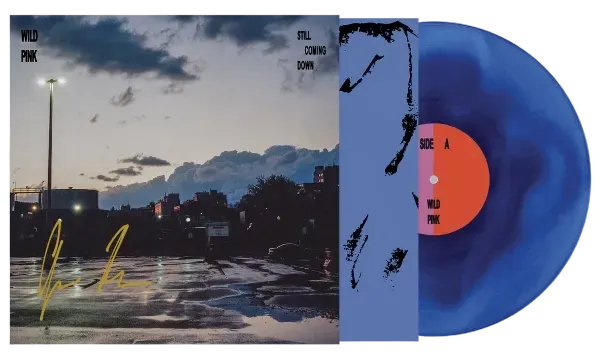
I’ve noticed that whenever I recommend Wild Pink’s Still Coming Down to a friend, I end up talking about Don DeLillo’s Libra. Granted, I’ll use any excuse to bring up one of my favorite novels. But if you’ve ever gone down a JFK assassination rabbit hole and emerged hours later with 37 browser tabs open and serious questions about Jack Ruby, boy, do I have the record and book for you.
The obvious connection is “Round of Applause at the End of the World,” a Song of the Year contender that dives into Kennedy assassination lore. It’s practically begging to be paired with DeLillo’s decades-sprawling, fictionalized but disturbingly plausible account of what happened in Dallas, following Lee Harvey Oswald and a tangled web of CIA operatives and conspirators.

Allow me to gush about this book for a second. I’ve met plenty of DeLillo readers who’ve never gotten around to Libra, which is a damn shame because I consider it his masterpiece. White Noise gets much of the attention, Underworld gets the Great American Novel treatment, but Libra is peak DeLillo: paranoid, darkly funny, gorgeously written, and, as the author described it, a “story about our uncertain grip on the world.”
And that description could easily apply to John Ross’s songwriting. His lyrics are full of paranoia, gallows humor, and wonderfully strange observations about American life, delivered over some of the finest indie rock being made today. Like DeLillo, he has a way of making the absurd feel unsettlingly familiar.
Libra is an all-timer, and Still Coming Down is making a strong case for my year-end list. Read one, listen to the other, and I’ll see you on the other side of the grassy knoll.
Home Is Where - Hunting Season (2025) → Flannery O’Connor - Wise Blood (1952)
Get Vinyl: Green, Purple, Brown | Splatter | Green
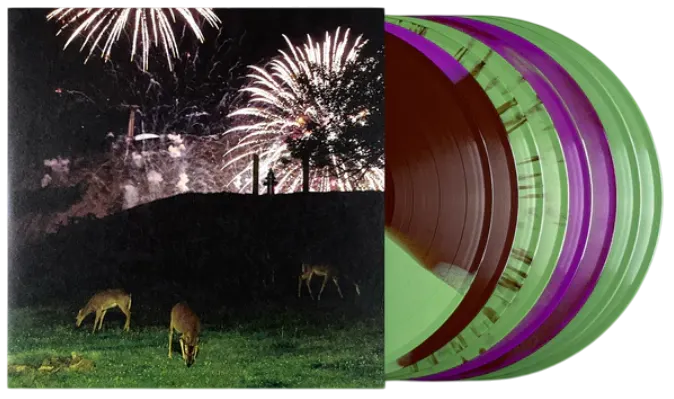
I curate a lot of Home Is Where in this museum. Maybe it’s because harmonica-laced screamo doesn’t come around every day. Maybe it’s because frontperson Bea MacDonald has a singing voice unlike anybody else. Or maybe it’s because we both grew up around Daytona Beach in the aughts, so I have a particular appreciation for her deliciously visceral lyrics about the weird, wonderful, deeply strange place we call home.
Take Hunting Season, a concept album about 13 Elvis impersonators dying in a 13-car pileup. Across its 13 tracks, you’ll encounter born-again drunk drivers, roadside memorials, and Judas Iscariot having a conversation with Pat Garrett. On opener “Reptile House,” God is a car crusher and heaven is a junkyard. It’s Southern Gothic literature with a healthy disregard for the speed limit.
Which brings us to Flannery O’Connor, the patron saint of Southern Gothic weirdness. Her 1952 novel Wise Blood follows Hazel Motes, a disillusioned war veteran determined to escape Christianity by founding his own Church Without Christ. Naturally, things go horribly wrong.

The book is populated by false prophets, religious fanatics, grifters, and enough grotesque Americana to fill a roadside attraction off I-95. Like Hunting Season, it’s violent, absurd, strangely funny, and obsessed with people looking for meaning in a world that seems determined to deny them any.
And Wise Blood has a surprisingly rich musical afterlife. Weyes Blood took her stage name from the novel, while Wednesday’s ripping opening track “Fate Is…” from their 2020 debut album also draws inspiration from it. Flannery O’Connor, your favorite indie band’s favorite novelist.
Rosalía - LUX (2025) → Clarice Lispector - The Passion According to G.H. (1964)
Get Vinyl: Crystal Clear
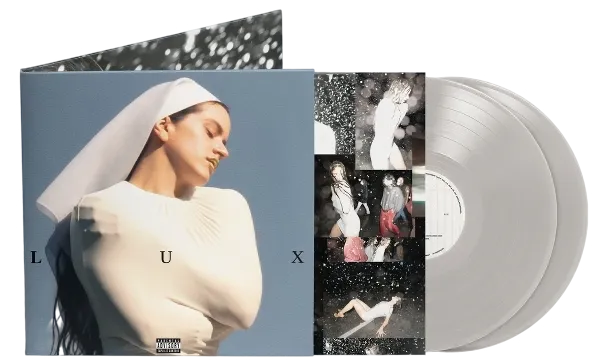
This one’s almost cheating, considering Rosalía has cited Brazilian novelist Clarice Lispector as an influence on LUX, her wildly ambitious, four-act pop opera exploring faith, femininity, and the divine across 13 languages. One critic dubbed the album “The Passion According to Saint Rosalía,” which makes Lispector’s novel The Passion According to G.H. a particularly fitting companion.

The premise: a wealthy woman enters her former maid’s room, encounters a cockroach, and crushes it in a wardrobe door. I have just told you 95% of the plot. What follows is 200 pages of stream-of-consciousness existential freefall, as our narrator questions her identity, her humanity, and her relationship with God.
Both works find spirituality in the flesh, where beauty, disgust, and desire become hopelessly tangled. Rosalía takes us on a grand, orchestral journey from earthly longing to death and transcendence. Lispector manages something similarly cosmic without leaving a single room.
If LUX sounds like a cathedral reaching toward heaven, The Passion According to G.H. feels like getting locked in a closet with God and a dead cockroach. And here’s another difference: I keep returning to LUX, while I have no desire to put myself through Lispector’s novel again. One trip into that room was plenty.
American Football - LP4 (2026) → Richard Ford - Independence Day (1995)
Get Vinyl: Red
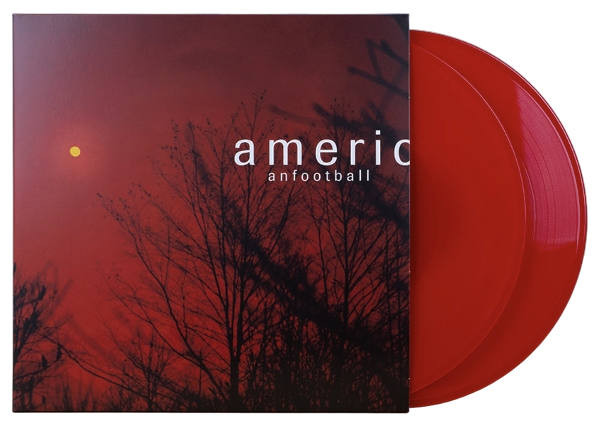
What happens when emo kids grow up? Nearly three decades after American Football’s debut became a touchstone for emotional college kids everywhere, Mike Kinsella is still singing about relationships falling apart. Except now he’s approaching 50, and the problems have gotten more complicated.
Their excellent fourth album tackles divorce, addiction, fatherhood, and regret with a certain gallows humor. On “Patron Saint of Pale,” Kinsella suggests settling his pending divorce with rock-paper-scissors. As drummer Steve Lamos (the real MVP of the record) puts it, the lyrics aren’t funny exactly, but there’s a “weird ‘fuck it’” attitude to them. Which is probably as reasonable a response to middle age as any.

Which brings us to Richard Ford’s Pulitzer Prize-winning Independence Day. Its narrator, Frank Bascombe, is a divorced New Jersey real estate agent attempting to reconnect with his troubled teenage son over a Fourth of July road trip to the baseball and basketball Halls of Fame. Frank has entered what he calls his “Existence Period,” a state of emotional detachment where he convinces himself he’s perfectly content with how his life has turned out. You can probably guess how that’s going.
Kinsella and Frank are both trying to figure out how to be decent fathers, navigate failed relationships, and make peace with lives that didn’t turn out as planned. The difference is that Kinsella puts his feelings out there for everyone to hear, often shockingly so, while Frank spends hundreds of pages talking himself out of having them. Both can be painfully funny, occasionally infuriating, and a little too relatable for comfort. I suspect Frank would find American Football absolutely exhausting, which might be exactly why he needs to hear them.
April + VISTA - Traditional Noise (2026) → Yoko Ogawa - The Memory Police (1994)
Get Vinyl: Translucent Fly Green
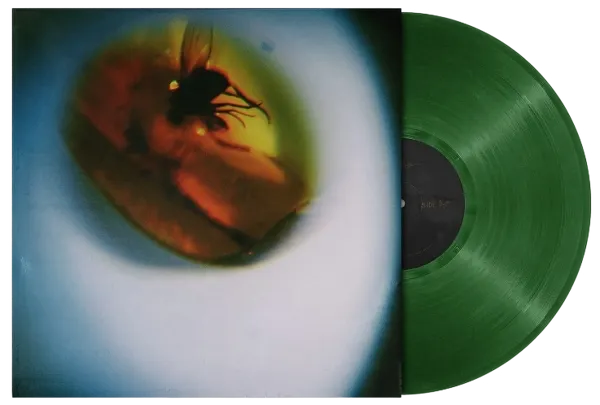
April + VISTA’s Traditional Noise is one of my favorite discoveries of 2026, a mesmerizing blend of experimental R&B, orchestral arrangements, and electronic textures that sound like they’ve been unearthed from another century. The duo describe their debut as an “amber-colored fossil,” a musical time capsule preserving the people, places, and memories they hold dear. And they mean it quite literally. The opening track, “Hello,” features recordings of friends and family, while “Two Evergreens” preserves April George’s childhood memories of her late grandmother and the trees she used to climb outside her house.
Yoko Ogawa’s The Memory Police imagines the exact opposite.

Set on a mysterious island where everyday objects periodically vanish, along with people’s memories of them, the novel follows a writer attempting to preserve what little remains while an authoritarian police force makes sure the past stays forgotten. Birds disappear. Roses disappear. Photographs disappear. Those who can still remember are hunted down, and even the narrator’s writing becomes an act of preservation in a world determined to erase its own history.
I read this during COVID, and it was one of my favorite books of that strange period. There’s some irony in that, considering how much of those years has since become a haze in my own memory.
There’s something I like about pairing an album obsessed with preservation with a novel about enforced forgetting. And as someone who spends an unreasonable amount of time collecting vinyl records, I appreciate the idea that physical objects are little repositories of memory. A record isn’t just music. It’s where you bought it, who you listened to it with, and the version of yourself who first fell in love with it. At least that’s what I’ll tell myself the next time I spend $50 on another colored pressing.
Let me know if you liked this issue. I’d love to turn this into a recurring series, as there were plenty of pairings on the cutting room floor.
Now it’s your turn. What’s an album that reminds you of a novel? Leave your pairings in the comments. Bonus points if they’re completely deranged.
Thanks for visiting, and I’ll see you Friday for The Weekender,
Jared
Brilliant feature. Will be checking out a few of these.